
Sensory. What the body is responding to.
The Sensory cards focus on environmental and bodily signals. Noise, light, proximity, and atmosphere influence the nervous system more than most people realise. When sensory load builds, attention and emotional regulation can shift quickly. These cards help identify those signals early, before overwhelm becomes difficult to manage. Your body is constantly providing useful information about what it needs.
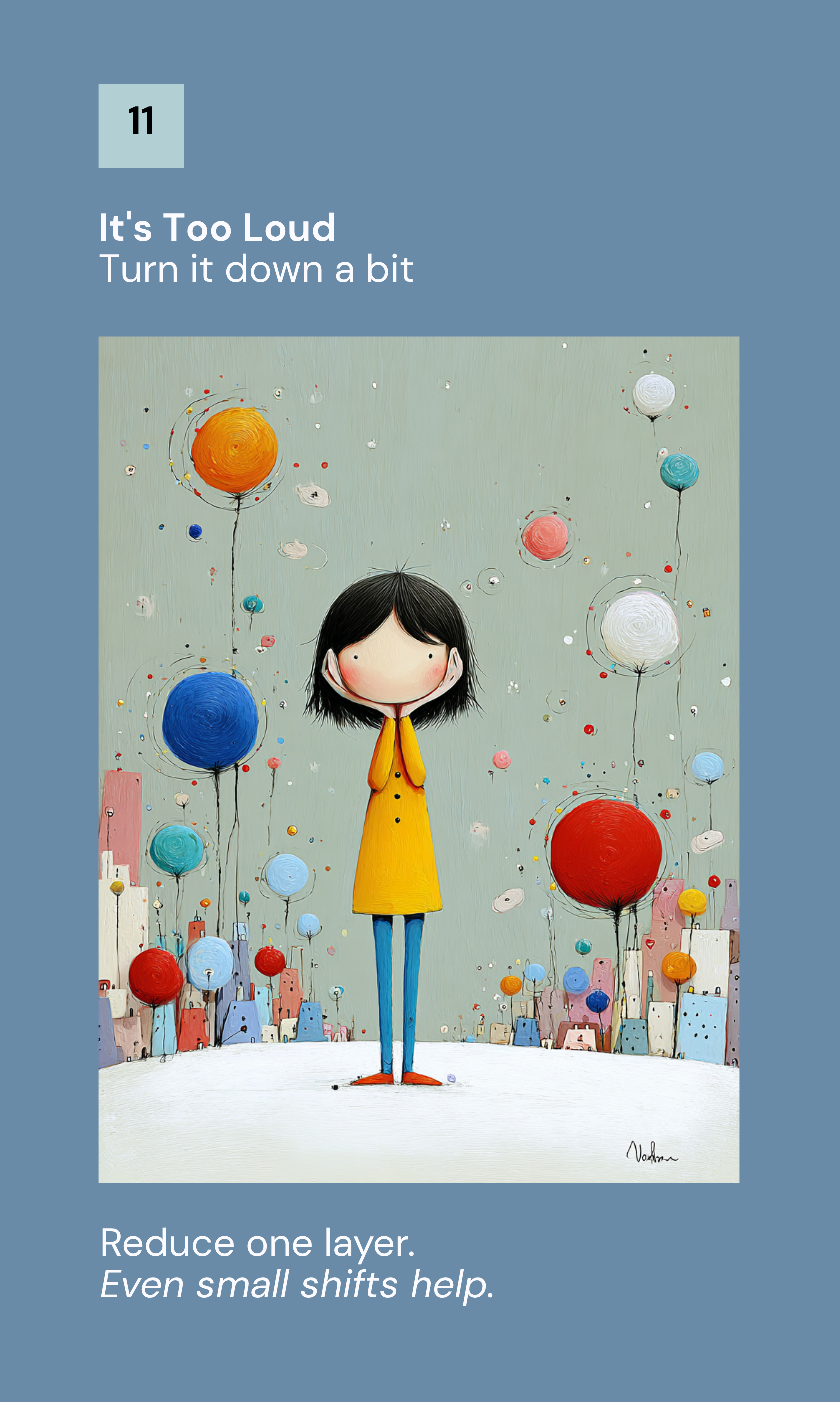
11. It's Too Loud. Turn it down a bit.
Context Overload builds gradually. Often you don't notice until irritation or fatigue sets in. Volume isn't just sound — input accumulates across channels, and what seems manageable individually can combine into genuine overload.
What This Card Offers This card is a cue to simplify input rather than endure it. You don't need to tolerate excess to prove capability. Adjusting the environment is not weakness. It's maintenance. Lower the volume. Step outside. Close a tab. Even small shifts matter.
Support Something in your environment is overwhelming your senses. It might be sound, conversation, movement, or digital noise. Reduce one layer if you can. Even a small shift helps.
Quiet Reassurance You are allowed to reduce what is too much. Protecting your sensory environment is a reasonable act.
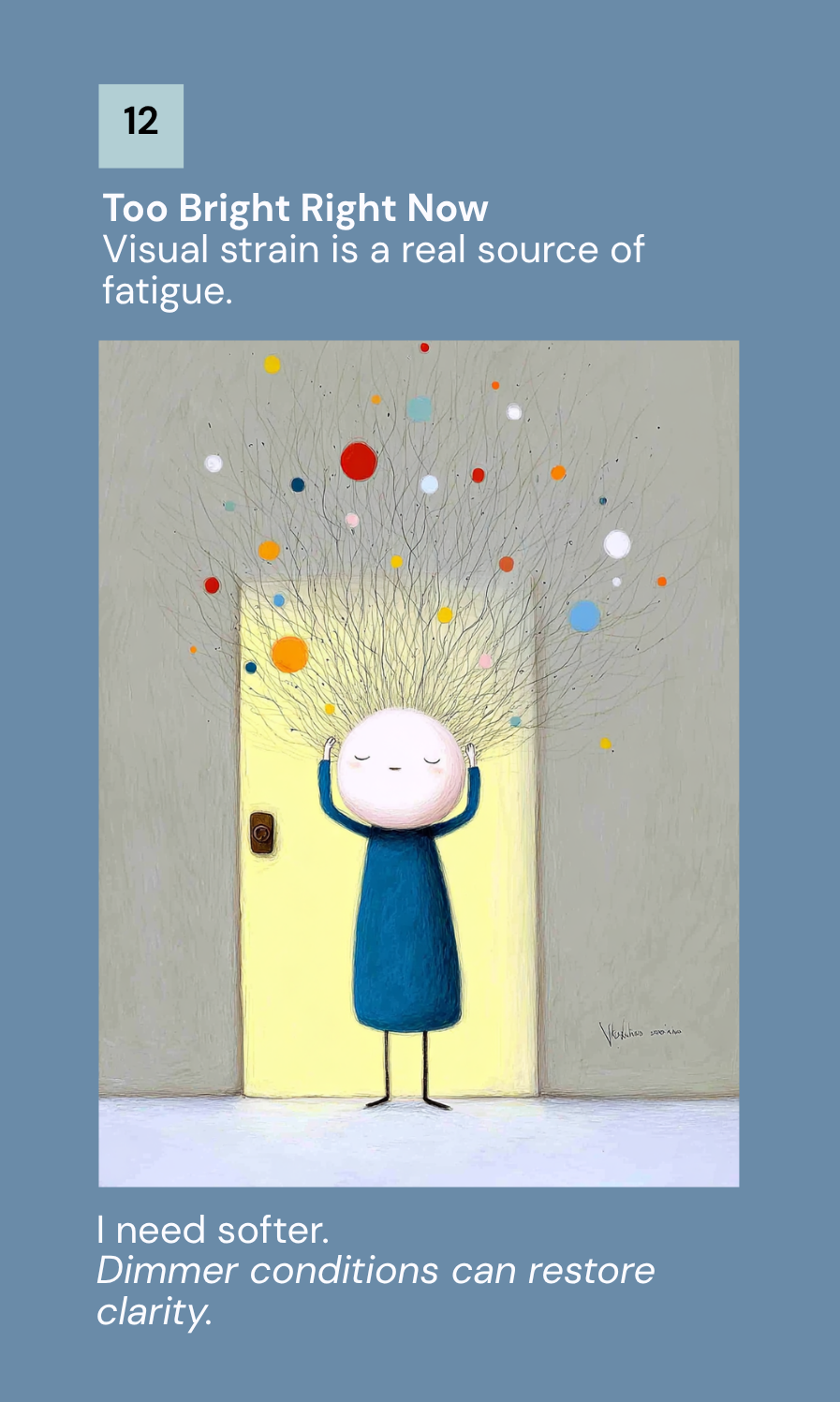
12. Too Bright Right Now. I need softer.
Context Visual strain is often overlooked as a source of fatigue. Light sensitivity can increase when tired or overstimulated, making environments feel harsh that would otherwise feel neutral. The connection between visual input and cognitive load is real.
What This Card Offers This card invites gentle visual reduction. Dim the lights. Turn down screen brightness. Look away for a minute. Close your eyes briefly. You are allowed to create softer conditions rather than pushing through glare or intensity.
Support Light and visual input may be draining you. Screen brightness, overhead lighting, and reflected glare all accumulate. Softening the environment can restore clarity.
Quiet Reassurance Softer conditions are not indulgent. Your visual environment is part of your sensory load.
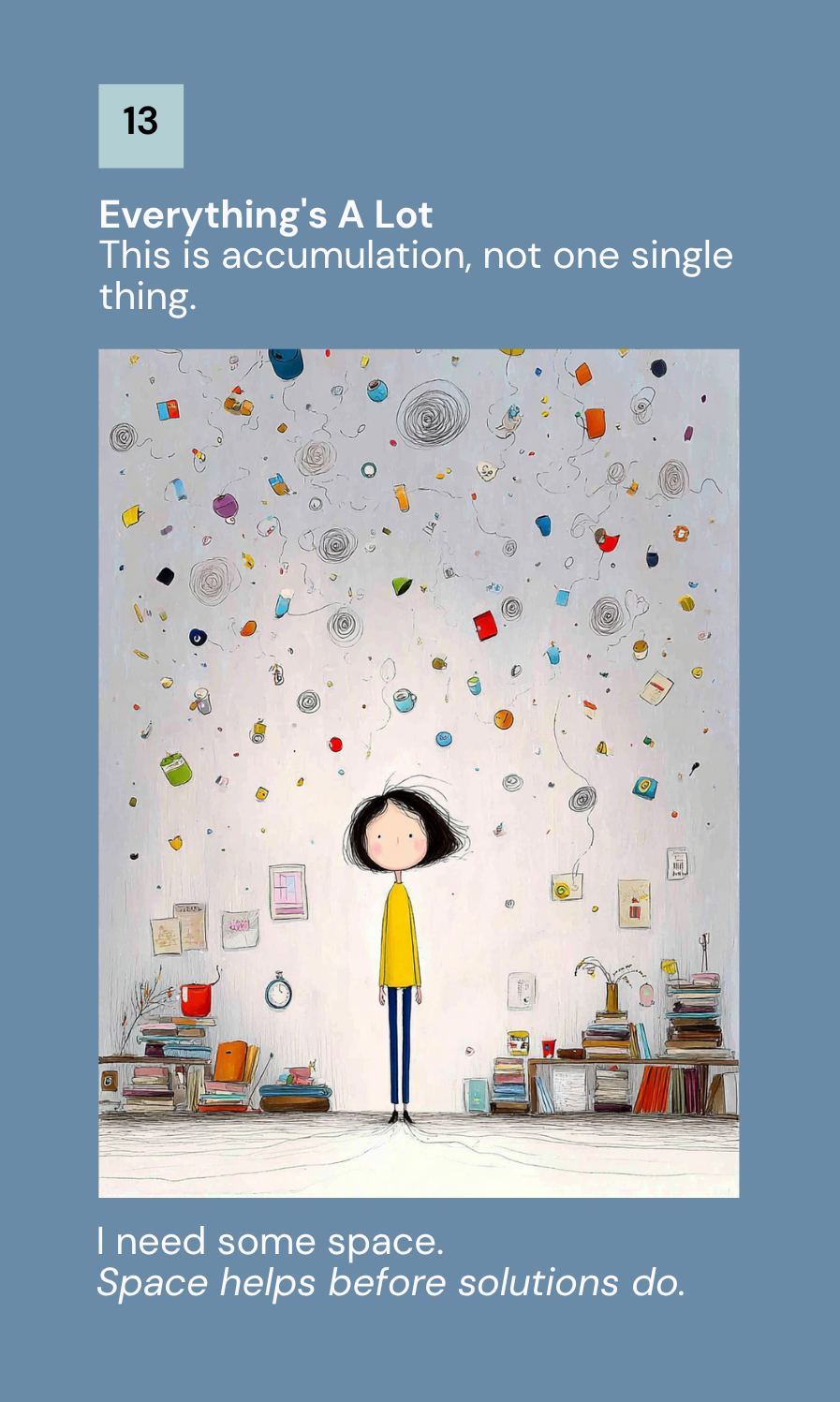
13. Everything's a Lot. I need some space.
Context Overload rarely has a single cause. Sound, light, social demand, task pressure, and physical discomfort can each be manageable alone but combine into something genuinely difficult. When overwhelm feels global, identifying the exact source is usually less useful than simply creating space.
What This Card Offers This card supports stepping back before solving. Leave the room if you can. Sit somewhere quieter. Reduce expectations for the next hour. You don't need to identify the exact cause before responding to it. Space helps the nervous system recalibrate.
Support It is not one thing. It is accumulation. Multiple inputs have compounded. The system needs space, not solutions. Reduction comes before analysis.
Quiet Reassurance You don't need to solve what's happening right now. Space is a legitimate first response.
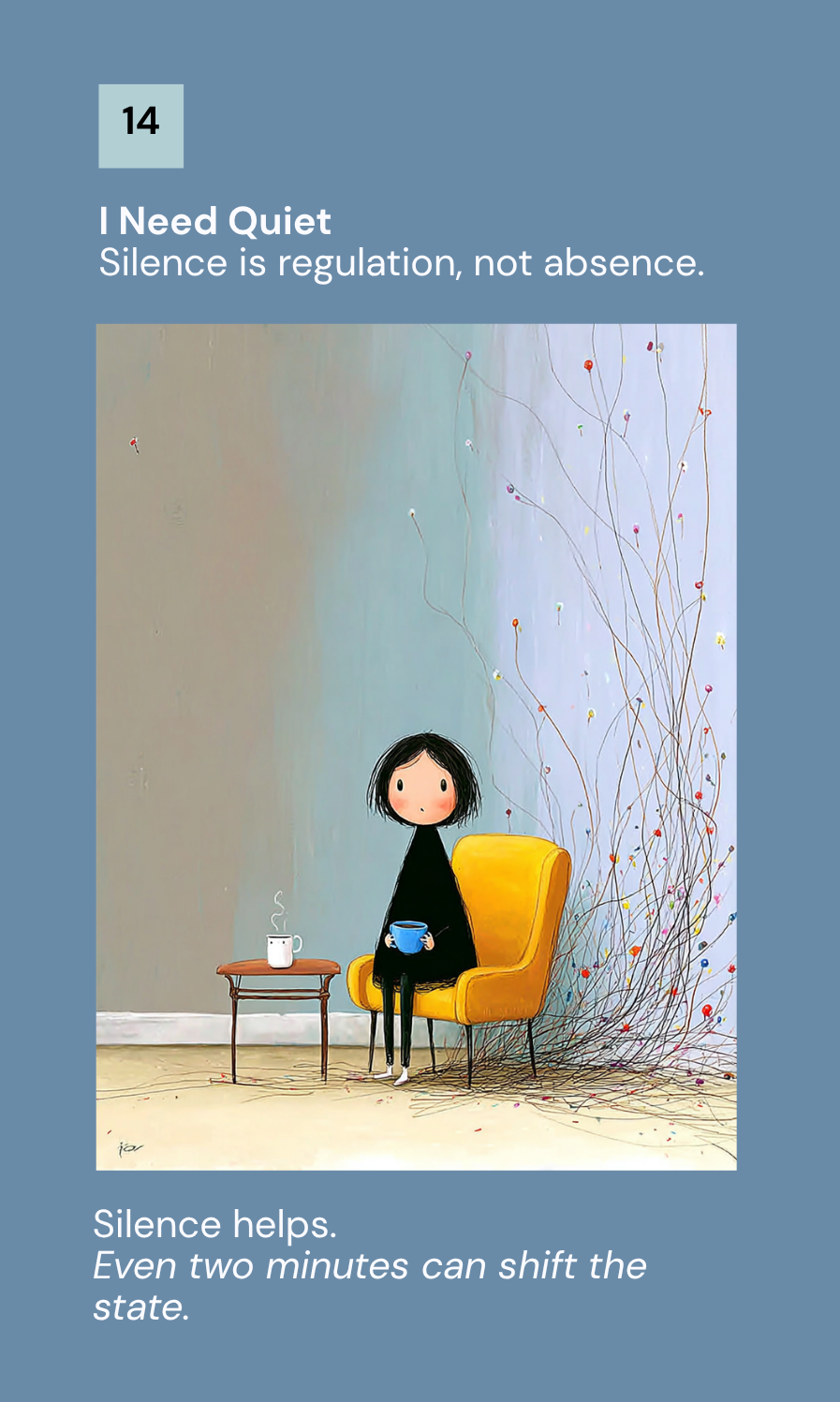
14. I Need Quiet. Silence helps.
Context Silence isn't an absence. It's a form of sensory support that allows the nervous system to settle. When input has been continuous, even low-level background noise can sustain a state of mild alertness that prevents real rest.
What This Card Offers This card invites you to turn off background noise, pause conversation, or use headphones if quiet isn't available. If you feel yourself tightening or getting reactive, silence can restore balance faster than explanation or problem-solving.
Support Your system is asking for less input. Background noise, conversation, and notification sounds all cost something. Even brief silence can shift your state. Quiet is regulation, not emptiness.
Quiet Reassurance Choosing silence is not avoidance. It is giving your system what it is asking for.
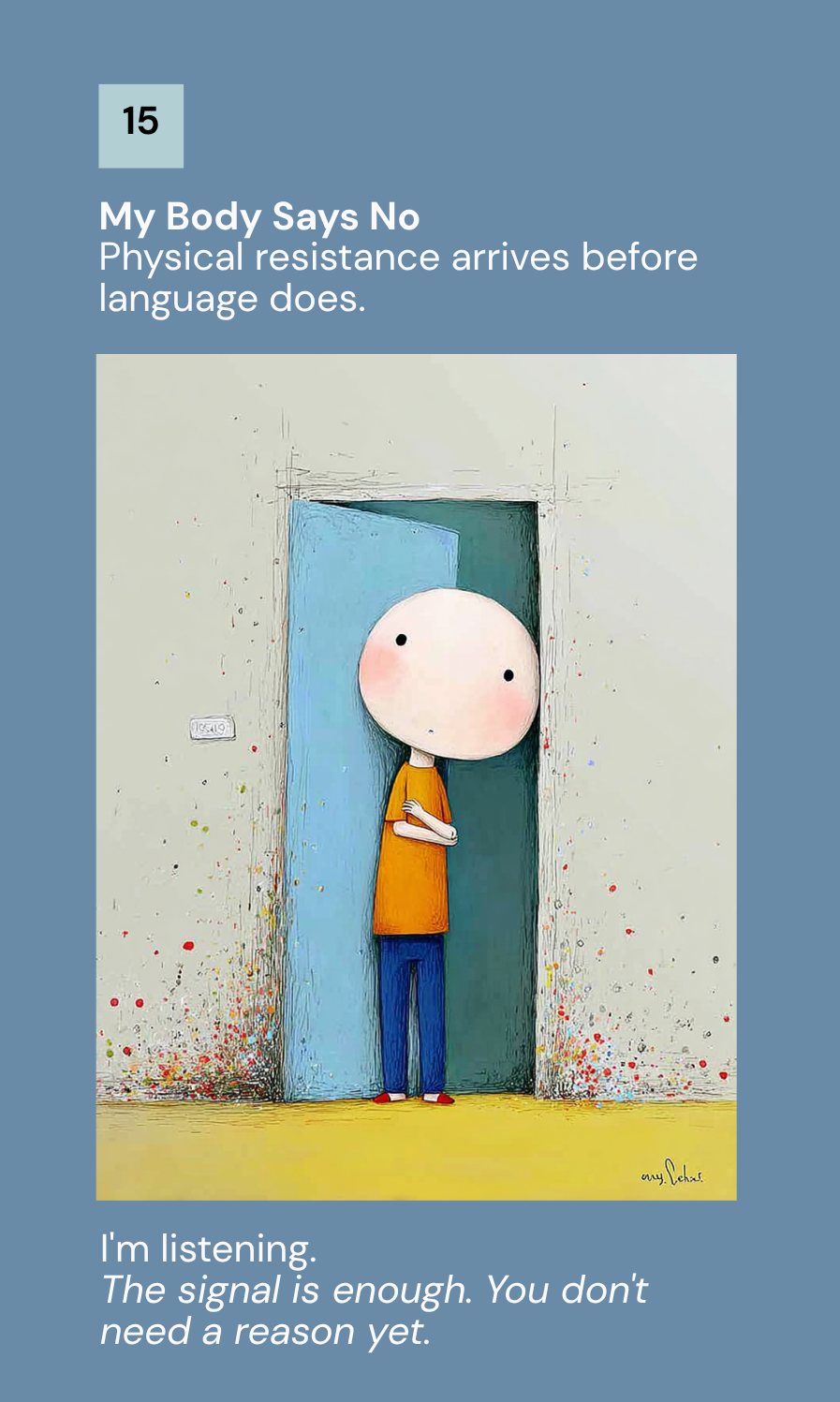
15. My Body Says No. I'm listening.
Context Bodily signals often carry information before the mind has organised it into language. Gut feelings, physical tension, and resistance are real data. They may not come with an explanation immediately, but they are usually pointing at something worth noticing.
What This Card Offers This card supports pausing before overriding the signal. You may not have a logical reason yet, and that's fine. Delay the decision if you can. Respecting bodily information builds self-trust over time, and often what the body is signalling becomes clearer once you stop pushing past it.
Support There is physical resistance present. Tightness, heaviness, or a pull back. This signal arrived before the words did. It deserves to be respected.
Quiet Reassurance You do not need language yet to respect what you are feeling. Bodily information is real information.
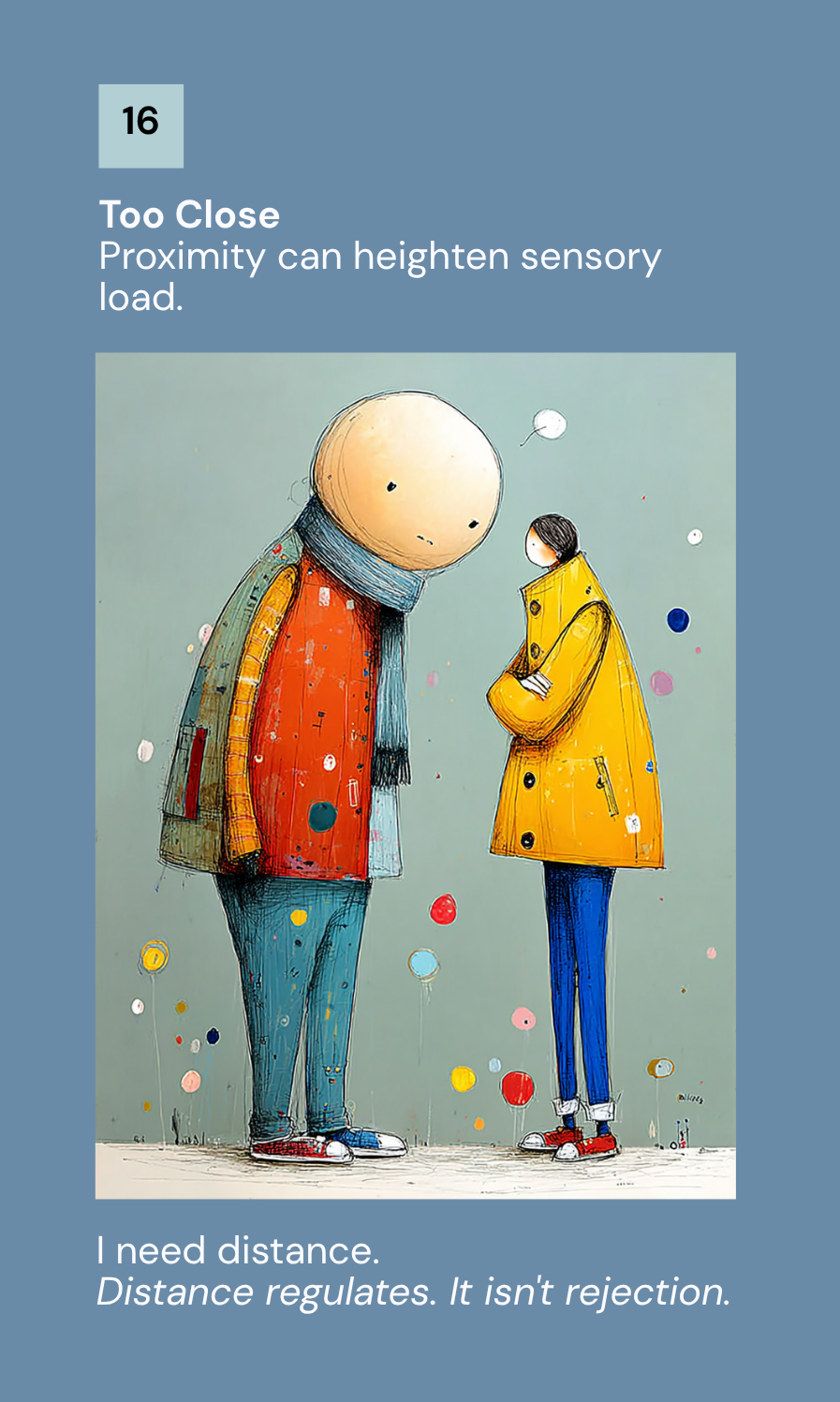
16. Too Close. I need distance.
Context Physical proximity can significantly increase sensory load, particularly when combined with other demands. The need for more physical space is a real and legitimate sensory experience, not a social preference or personality trait.
What This Card Offers This card supports creating a little more distance. Step back. Change seats. Shorten the interaction. You are not required to endure closeness that is overwhelming you. Distance regulates. It doesn't mean you dislike the person. It means you are pacing yourself.
Support Proximity feels intense right now. Physical or emotional closeness is heightening sensory load. Distance is a form of regulation. Creating space is not rejection.
Quiet Reassurance Needing space is a sensory reality, not a relational statement. Distance can be kind to everyone involved.
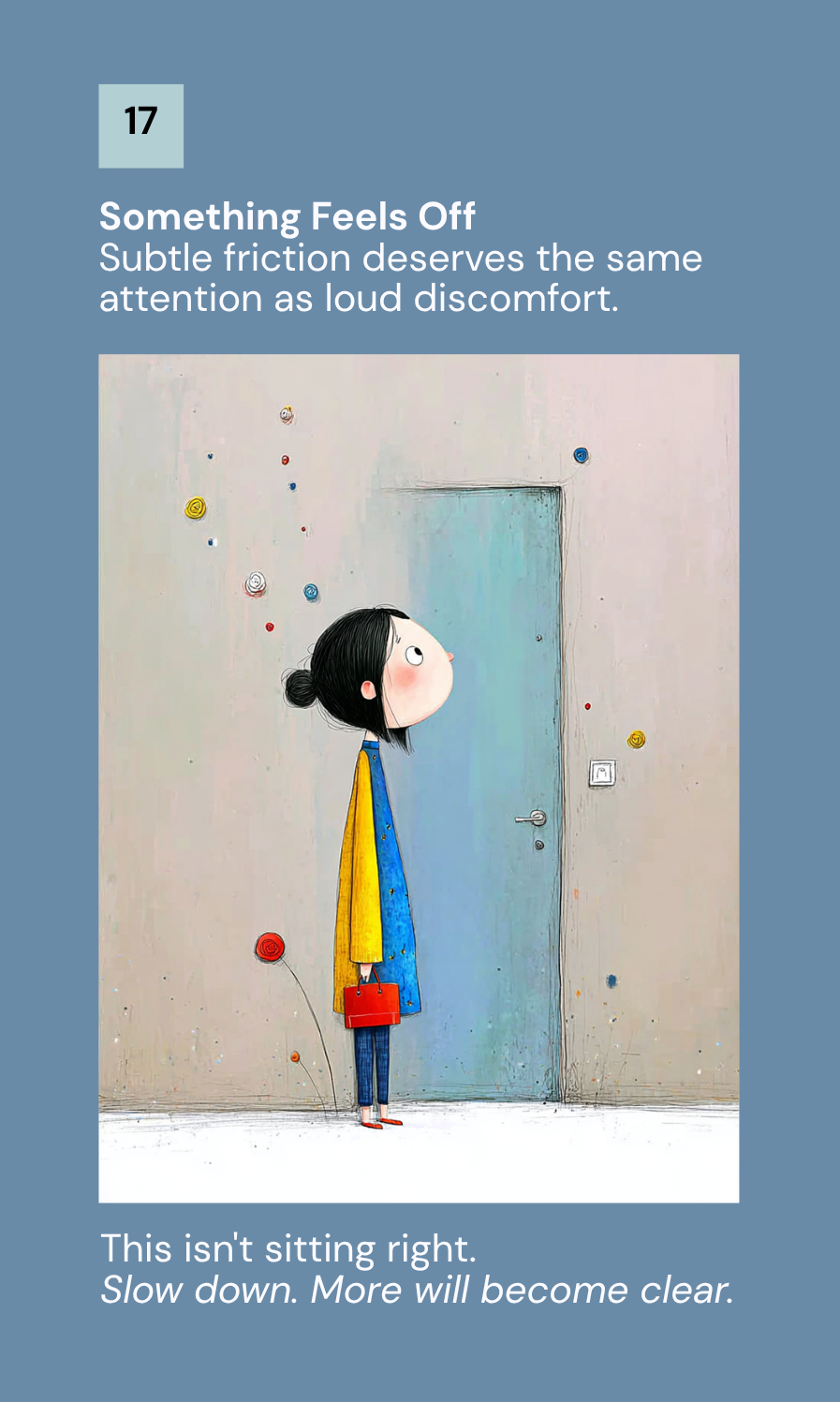
17. Something Feels Off. This isn't sitting right.
Context Not all discomfort is dramatic. Sometimes it is quiet misalignment — a sense that something is slightly wrong without a clear cause. This kind of low-level signal is easy to dismiss, but it often carries useful information.
What This Card Offers This card supports trusting the small signal rather than dismissing it. Slow down. Gather more information before committing further. You don't need certainty about what's off before you give yourself permission to pause. Often the clarity comes once you stop moving.
Support There is subtle friction present. Something about this moment or situation is not landing well. You don't need to name it yet. The signal itself is enough information to slow down.
Quiet Reassurance Subtle discomfort is worth taking seriously. You don't need a full explanation before you slow down.
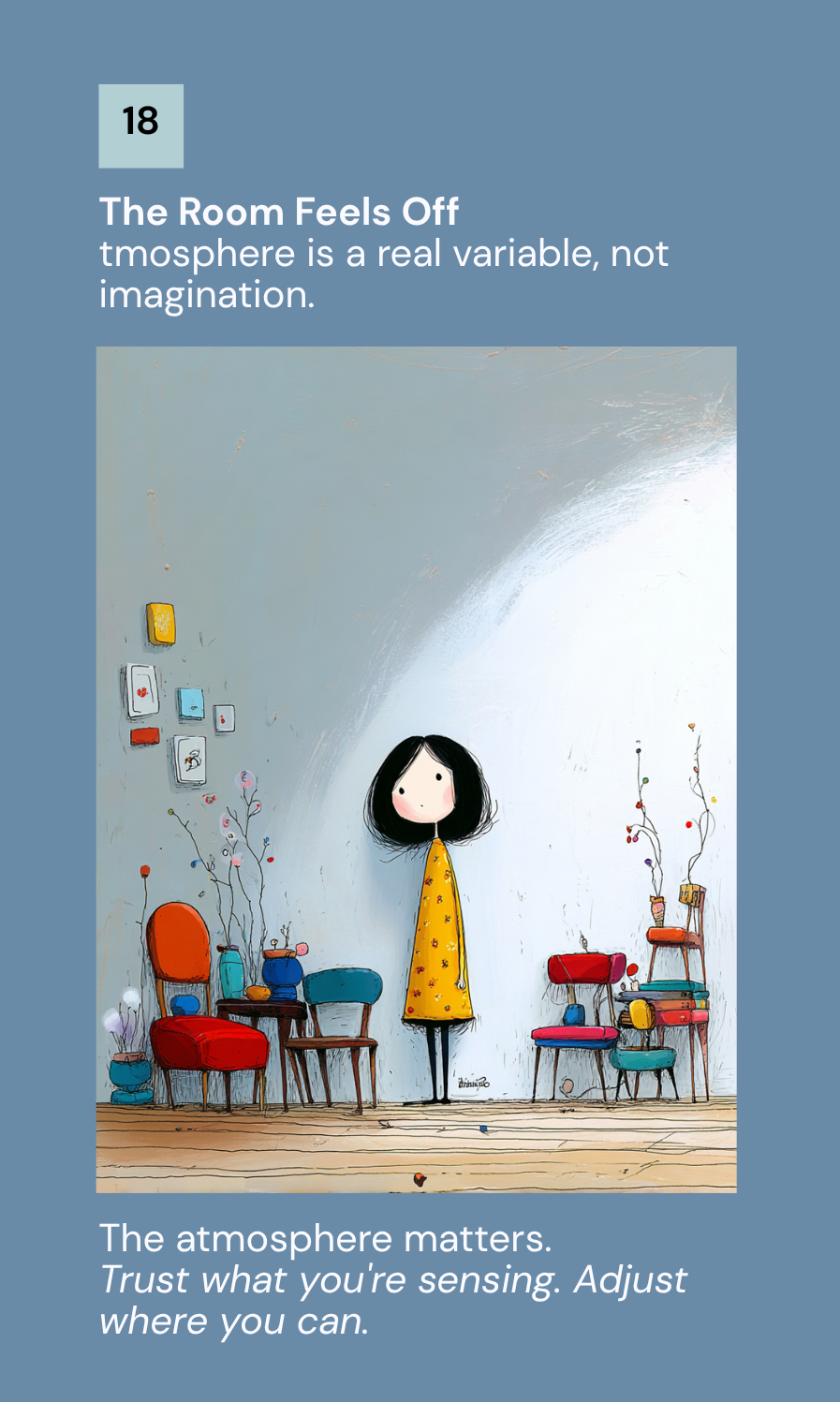
18. The Room Feels Off. The atmosphere matters.
Context The atmosphere of a space influences regulation in ways that aren't always visible. Lighting, layout, temperature, background tension, and social dynamics all affect how the nervous system reads an environment. Sensitivity to these shifts is useful information, not oversensitivity.
What This Card Offers This card affirms that your awareness of the room is legitimate. If possible, change position, change rooms, or name the shift to yourself. Trust that the discomfort is pointing at something real. Adjusting to a different space or posture can change how the moment feels.
Support The mood or energy of the environment has shifted. Something in the social or physical space feels different. You are not imagining it. Atmosphere is a real variable.
Quiet Reassurance You are not imagining the atmosphere. Responding to it is reasonable.
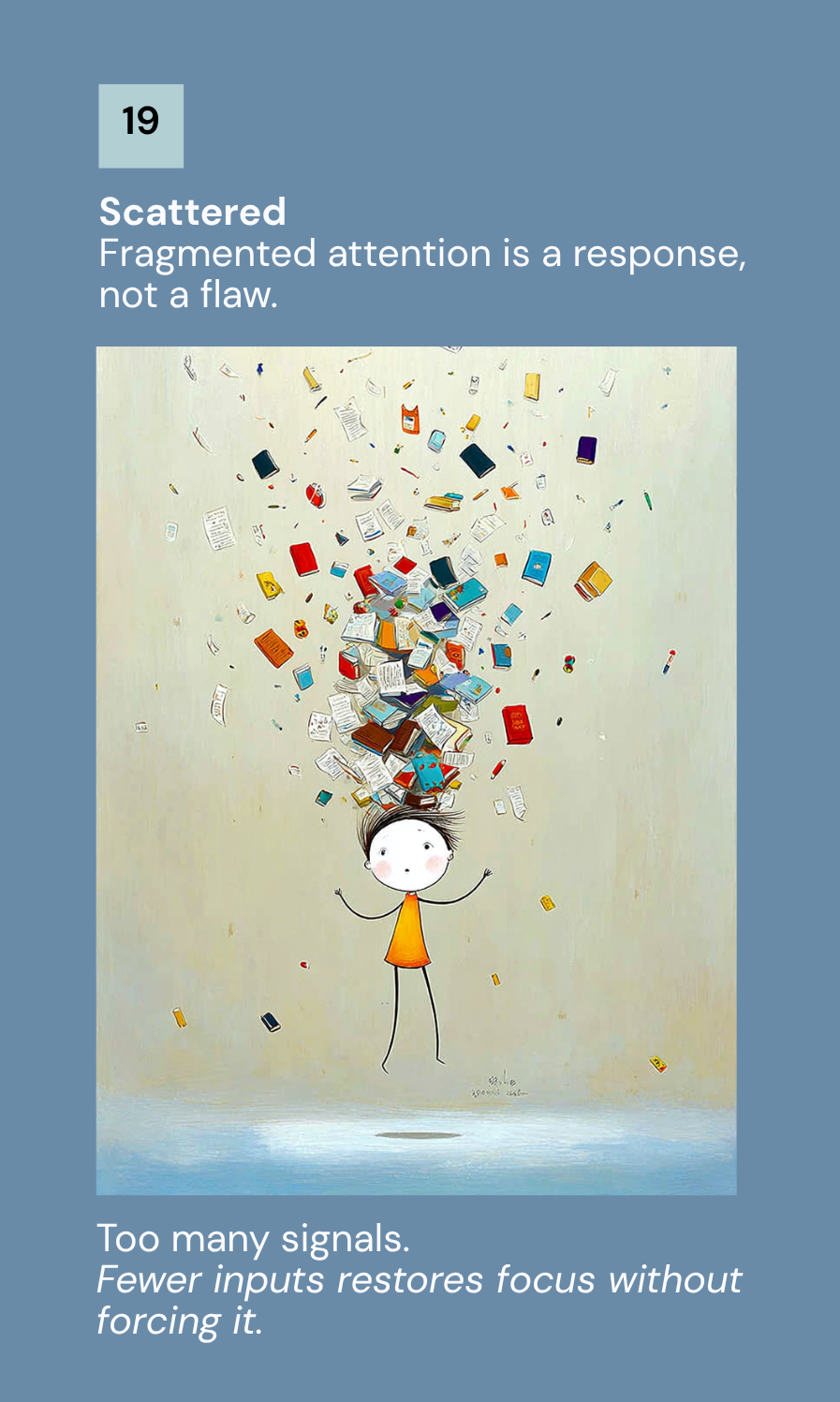
19. Scattered. Too many signals.
Context Scattered attention is often a response to overstimulation rather than a failure of willpower. When too many signals compete simultaneously — notifications, conversations, tasks, physical discomfort — the attentional system fragments across them.
What This Card Offers This card supports simplifying input rather than forcing focus. Close extra tabs. Silence notifications. Write one short list to externalise the noise. Scattered attention often resolves when the environment is quieted rather than when more effort is applied.
Support Attention is being pulled in multiple directions. Focus has fragmented. Simplifying the inputs will help. This is a response to the environment, not a character flaw.
Quiet Reassurance You are not failing at focus. You are responding to an overloaded environment.
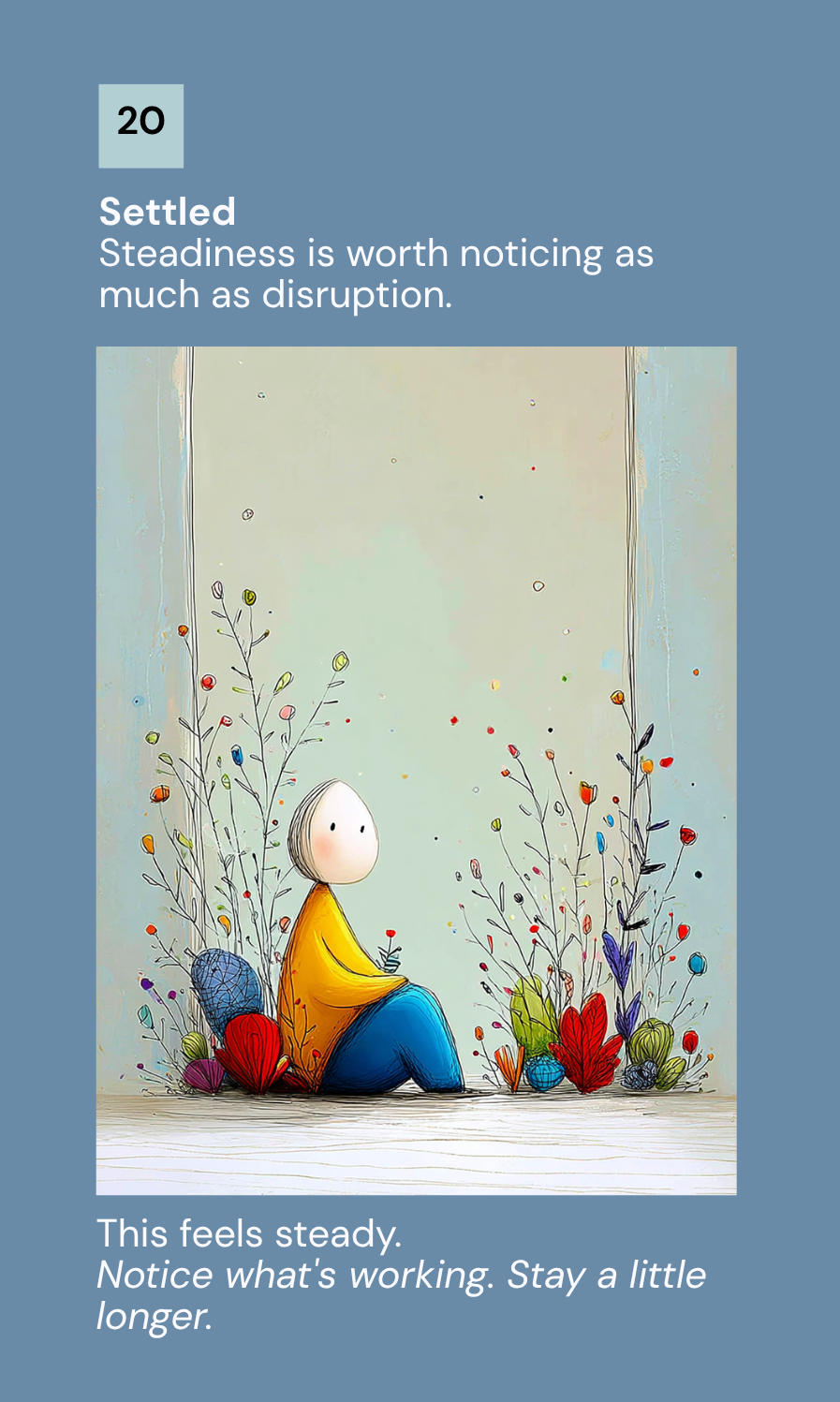
20. Settled. This feels steady.
Context It is easy to pay close attention to disruption while moving quickly past calm. But steadiness carries useful information too. Noticing what conditions create it, what the body feels like when it's present, and what tends to precede it helps build an accurate map of what supports you.
What This Card Offers This card invites you to stay with the settled feeling rather than immediately filling it. Notice what's working. Replicate the conditions if you can. Study your own calm as carefully as you study your overwhelm. Both are part of understanding your system.
Support Your system feels calm. The environment is supporting you right now. Steadiness is worth noticing. You can stay here a little longer.
Quiet Reassurance Calm is information too. Noticing it is part of learning what supports you.
Full Guidebook
-
Today Suit
Cards 1 - 10
-
Sensory Suit
Cards 11 - 20
-
Energy Suit
Cards 21 - 30
-
People Suit
Cards 31 - 40
-
Care Suit
Cards 41 - 50