
People. How connection is landing.
Connection can restore energy or quietly drain it. The People cards explore the social side of regulation: boundaries, conversation dynamics, communication slips, and the energy required to interact with others. They recognise that social life often involves subtle effort. These cards help you notice where interaction feels heavy, where it feels easy, and where small adjustments may help.
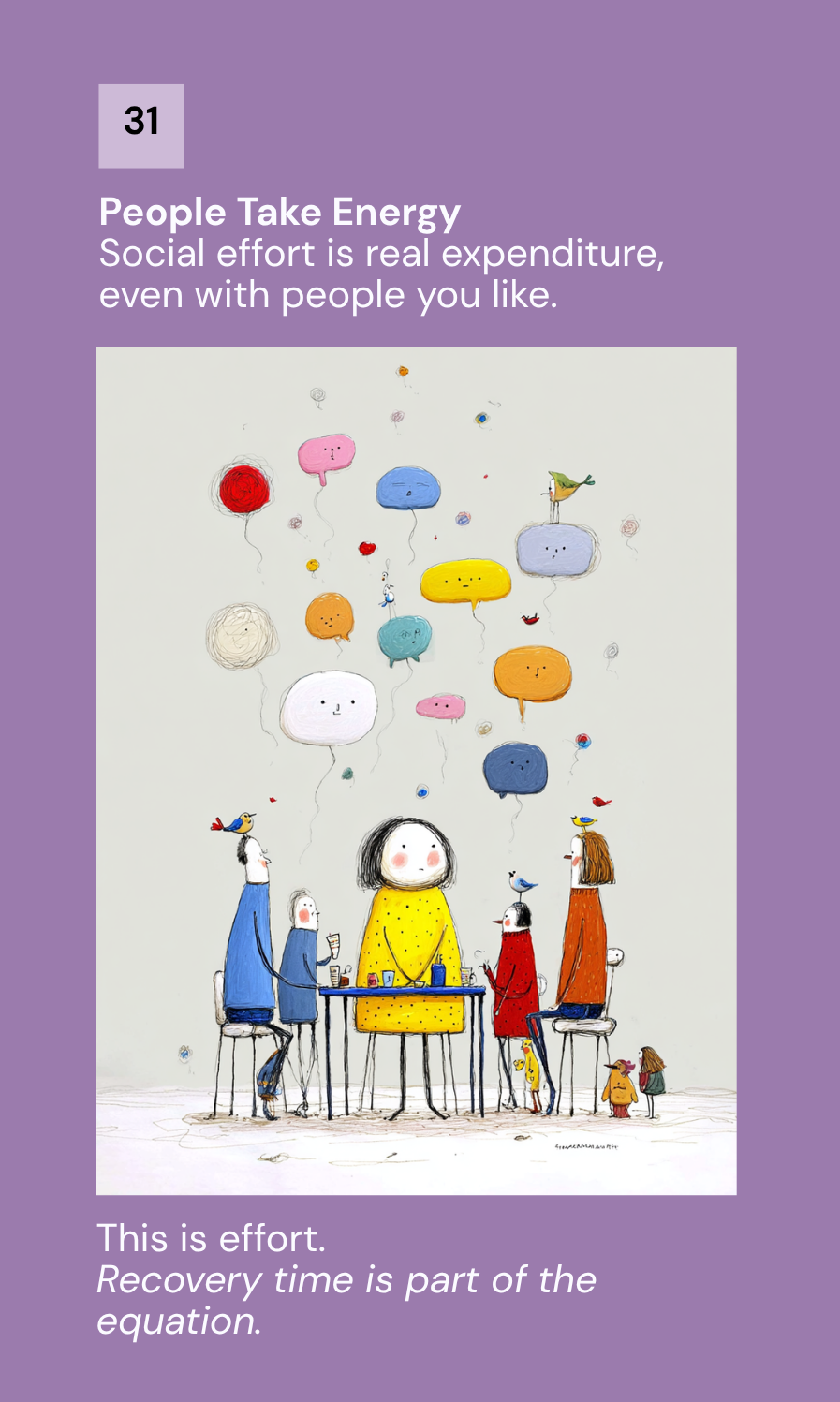
31. People Take Energy. This is effort.
Context Social interaction draws on cognitive and emotional resources in ways that aren't always visible. Reading the room, tracking conversation, managing self-presentation, and responding to the needs of others all involve real effort. Some days that effort is manageable. Other days it depletes quickly.
What This Card Offers This card normalises the cost. Plan recovery time if you can. Shorten the interaction slightly if you need to. Step outside for a minute. You are not antisocial for needing recharge time after being with people. You are pacing yourself.
Support Being around others costs energy, even when you like them. That is not a sign something is wrong. Social energy is real expenditure. Recovery time is part of the equation.
Quiet Reassurance Needing to recover from social time is not a character flaw. It is part of how your system works.
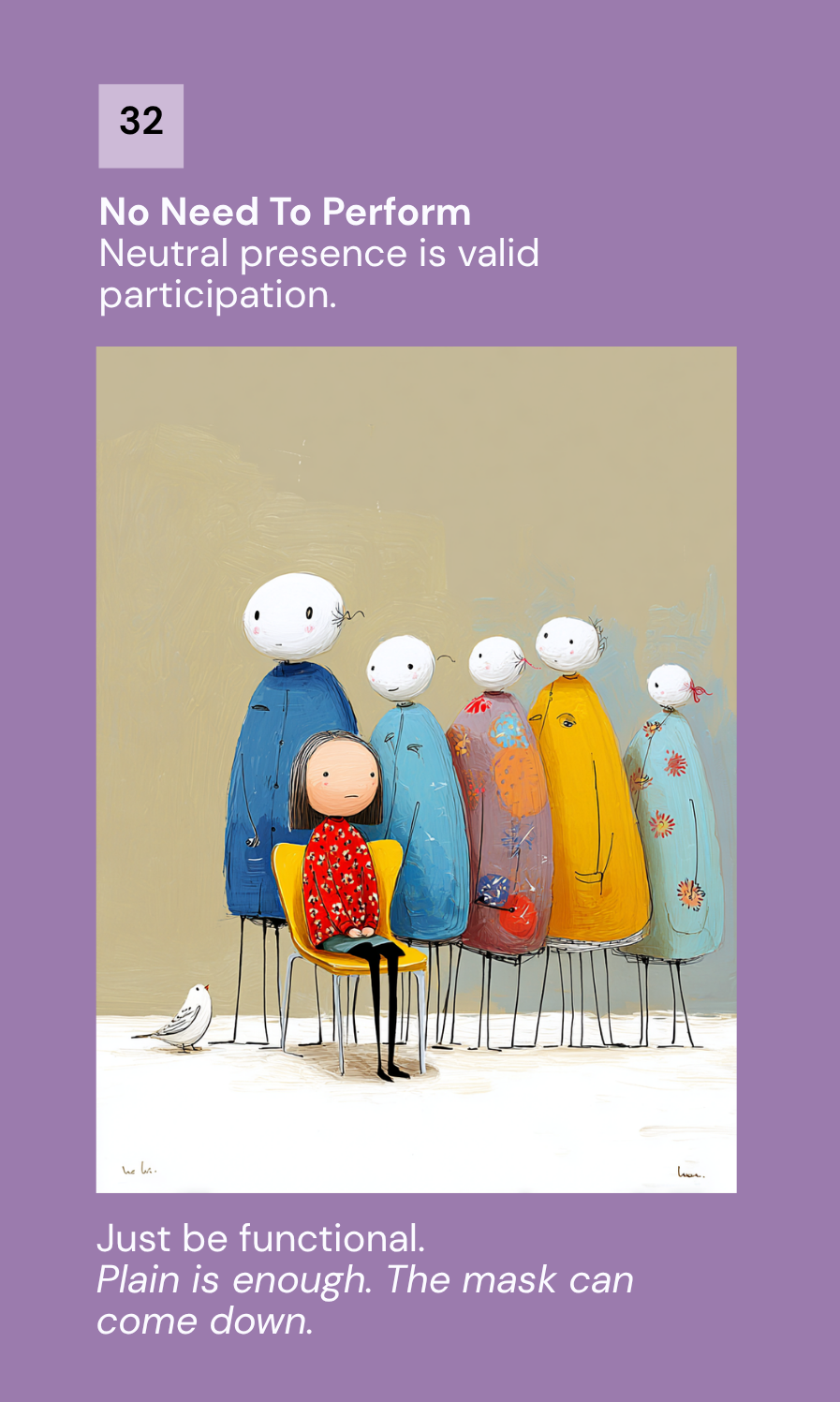
32. No Need to Perform. Just be functional..
Context Performance often slips in unnoticed. Smiling more than you feel. Explaining beyond what was asked. Amplifying enthusiasm to match a room. Masking discomfort or difficulty to appear more capable. These are all real energy expenditures that compound over time.
What This Card Offers This card loosens that demand. You can participate without amplifying yourself. Being functional and present is enough. You don't need to manage how you're landing on others right now. Let the mask down a little.
Support You don't have to be charming, animated, or impressive. Neutral is allowed. Quiet presence is real participation. Plain is enough today.
Quiet Reassurance Being unremarkable in a conversation is allowed. Presence is enough without performance.
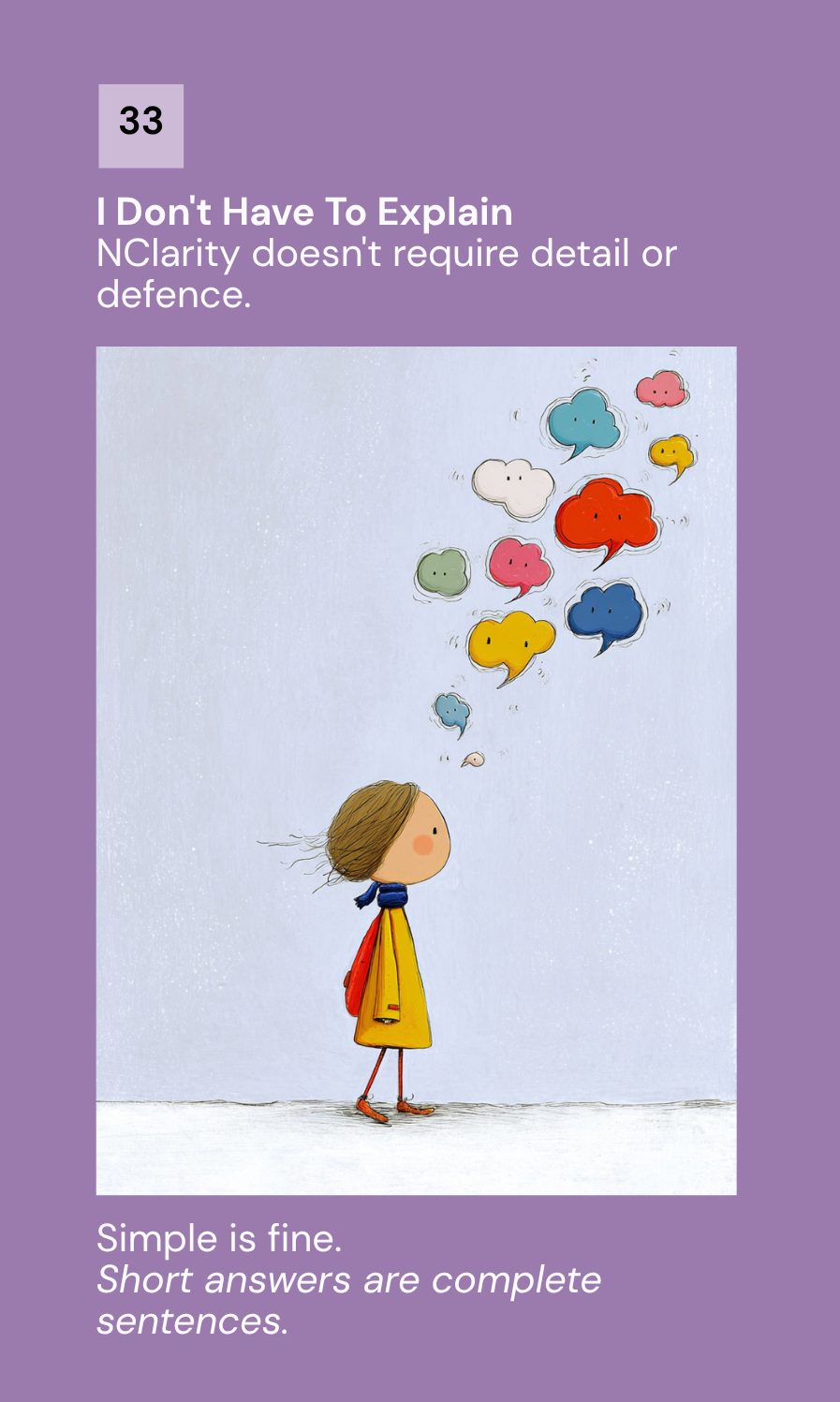
33. I Don't Have to Explain. Simple is fine.
Context Over-explaining is often a habit born from past experiences of being misunderstood, questioned, or not believed. It can feel necessary as a form of pre-emptive protection. But it often costs more energy than it protects, and frequently doesn't change the outcome.
What This Card Offers This card supports brevity. "I can't." "Not today." "That doesn't work for me." These are complete sentences. Short answers are valid. You are not obligated to make your reasoning convincing. A limit stated simply is still a limit.
Support You are not required to justify every choice or boundary. A short response works. Clarity does not require detail. Your limits do not require defence.
Quiet Reassurance You don't owe an explanation for your needs. Short and clear is enough.
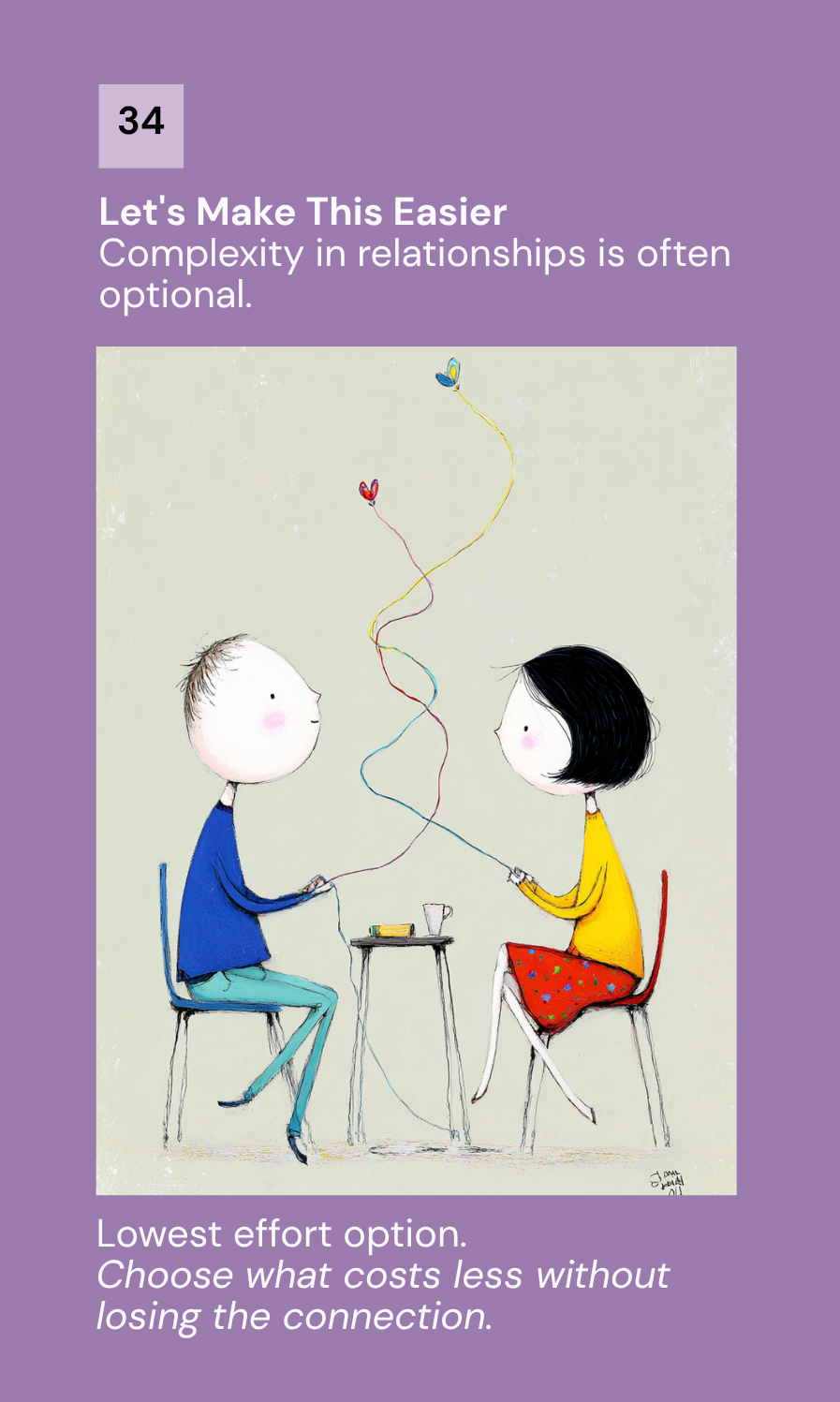
34. Let's Make This Easier. Lowest effort option.
Context Relational strain often builds through unnecessary complexity. Meetings that could be a message. Conversations that require full presence when they could be asynchronous. Social commitments that grew beyond their original shape. When interactions are more demanding than they need to be, it costs more than it should.
What This Card Offers This card supports streamlining. Shorter meeting. Fewer people. Clearer agenda. Choose the option that costs less without abandoning the connection entirely. You are allowed to prefer efficiency over endurance in your social life.
Support Choose the simpler version of this interaction. Shorter, clearer, less complex. Ease is a legitimate preference. Reducing friction is not laziness.
Quiet Reassurance Making things easier is a valid strategy. Simplicity is not avoidance.
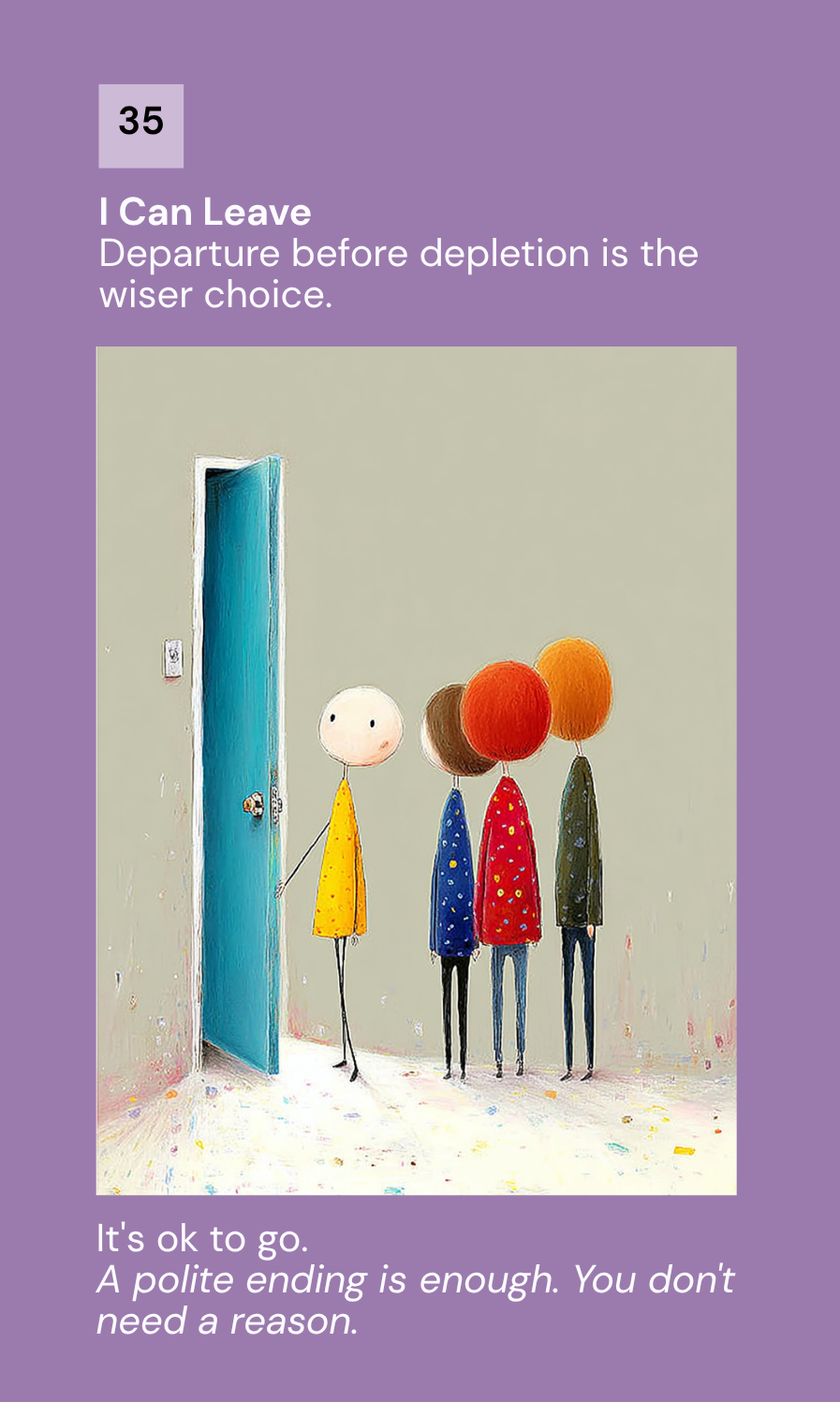
35. I Can Leave. It's ok to go.
Context Staying past your limit in social situations often creates resentment and fatigue that takes longer to recover from than an early exit would have. The habit of enduring rather than leaving is common, particularly when leaving feels impolite or like a failure of social obligation.
What This Card Offers This card legitimises departure. You are allowed to leave early. A brief excuse or simply thanking someone and heading out is sufficient. You don't need to explain or justify. Leaving on your own terms, before you've fully depleted, is often the wiser choice.
Support You are allowed to exit. Physically or conversationally. A polite ending is enough. You don't need to wait for depletion.
Quiet Reassurance Leaving early is not a social failure. It is managing your energy responsibly.
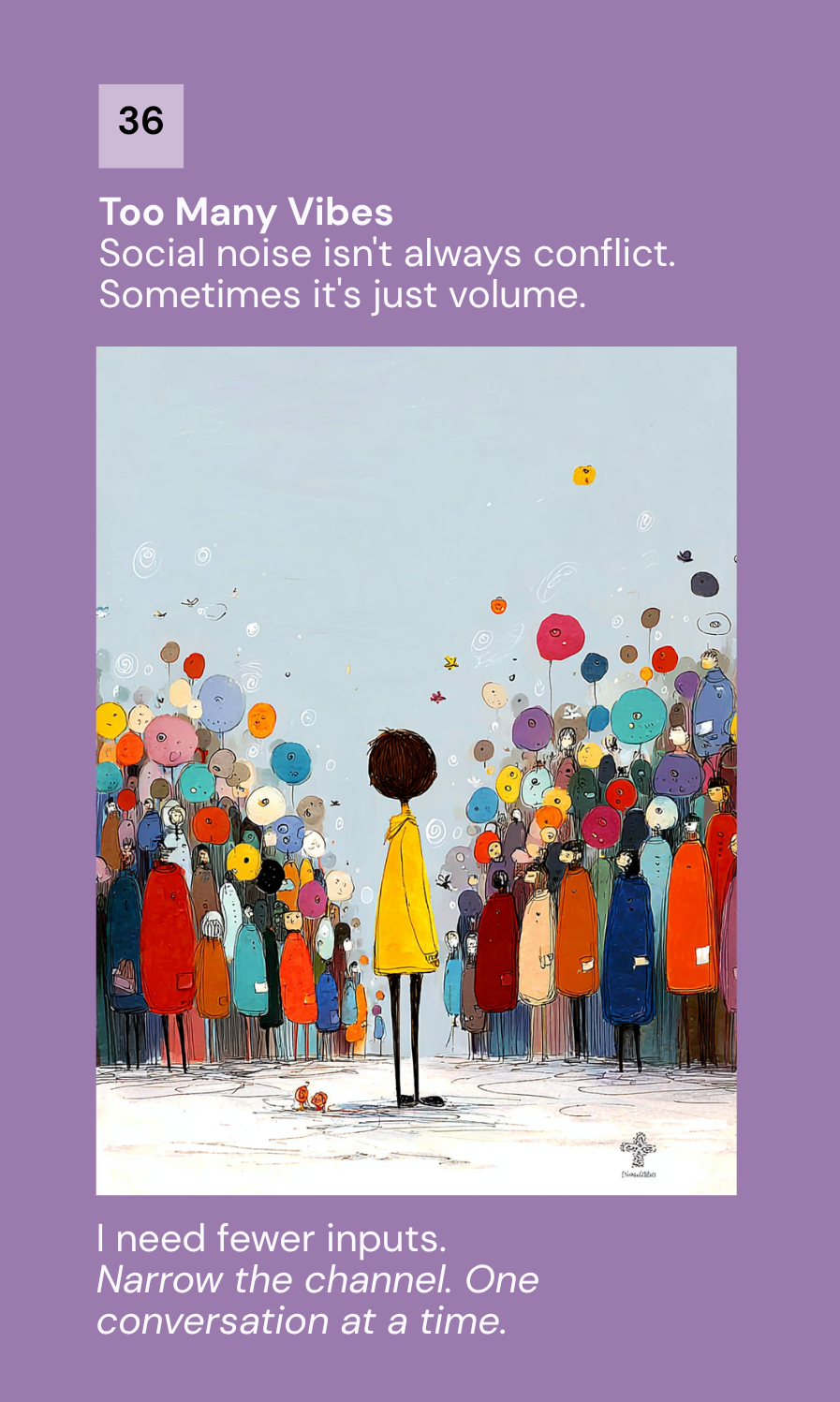
36. Too Many Vibes. I need fewer inputs.
Context Social noise isn't always conflict. Sometimes it's simply volume. Too many people, too many simultaneous threads, too many emotional tones to track at once. The attentional and empathic systems can become overloaded when the social environment is too complex.
What This Card Offers This card encourages reducing social input to something more manageable. Mute a thread. Step out of the group and speak to one person. Narrow the relational field for a period. You don't have to hold everything and everyone right now.
Support Multiple social inputs are crowding your thinking. Opinions, dynamics, and emotional tones are overlapping. Narrowing the channel will help. You don't have to absorb everything at once.
Quiet Reassurance You are not obligated to track every dynamic. Fewer inputs is a legitimate need.
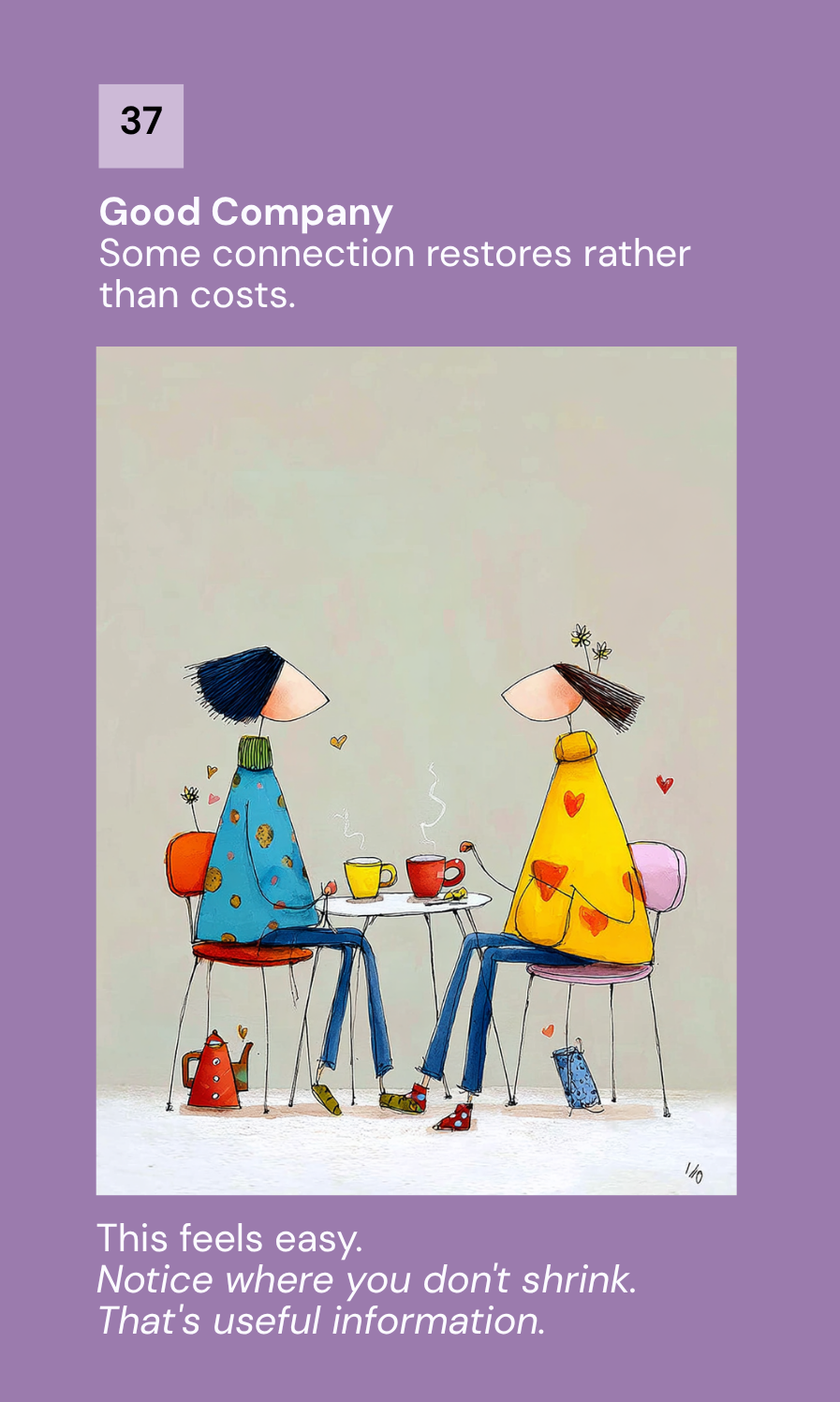
37. Good Company. This feels easy.
Context Not all connection is costly. Some people regulate your nervous system rather than depleting it. Some conversations feel genuinely easy. These moments are as important as the difficult ones, and paying attention to what makes them different is useful information.
What This Card Offers This card reminds you to study ease as much as you study effort. Stay a little longer if it feels good. Notice what's different here — the pace, the tone, the absence of performance pressure. Those patterns reveal what good connection actually looks like for you.
Support This interaction is restoring rather than draining. Something about it feels different. Connection can replenish as well as cost. This is worth noticing.
Quiet Reassurance Notice where you don't shrink. Good company is information about what supports you.
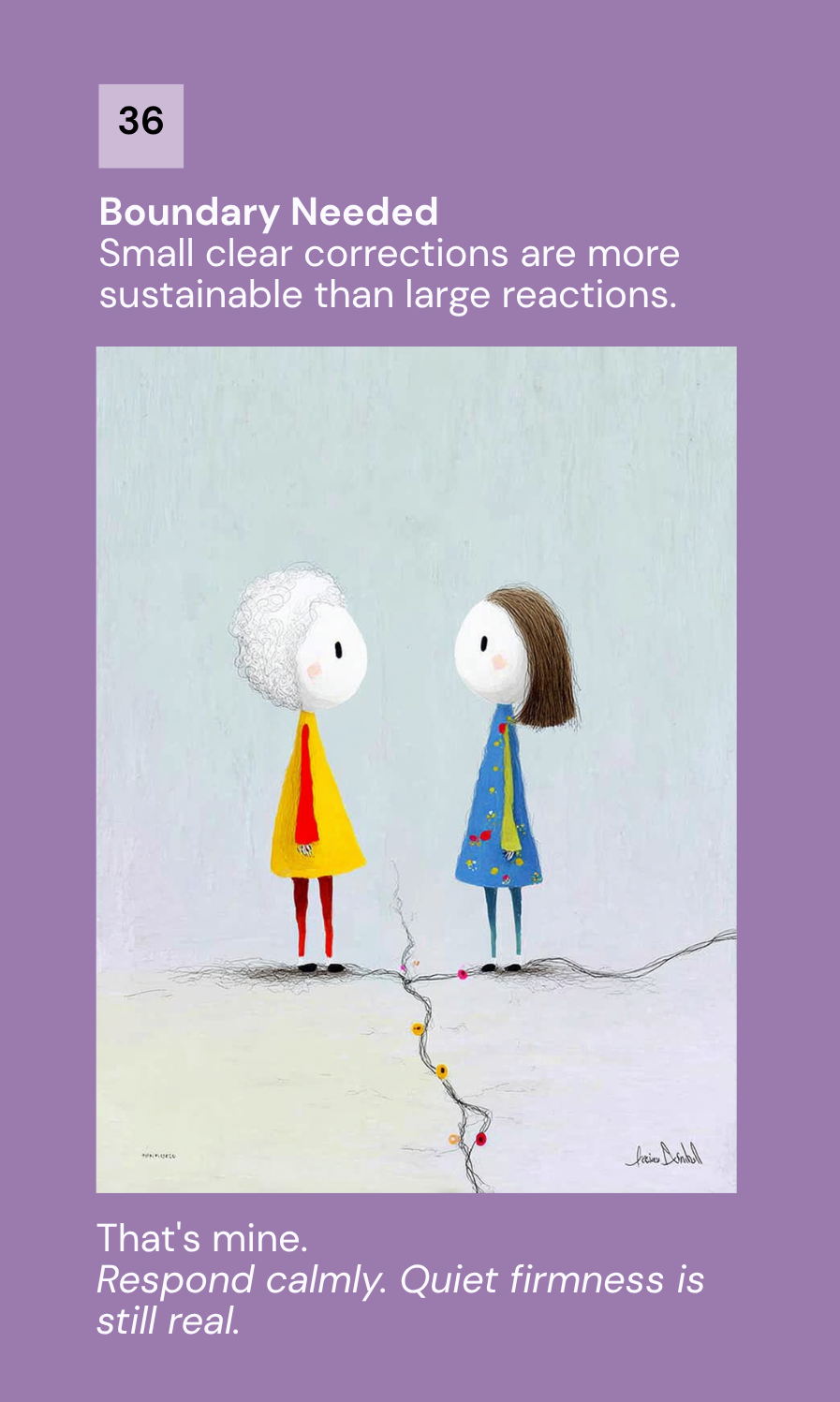
38. Boundary Needed. That's mine..
Context Boundaries don't require drama to be effective. Small, clear corrections are often more sustainable than large reactions. The moment something crosses your edge is the right time to respond, not later when it has accumulated into something harder to address.
What This Card Offers This card supports quiet firmness. Clarify. Step back. Adjust the expectation. "That doesn't work for me." "I need a little more space." You are reclaiming something that belongs to you. The response can be calm and still be real.
Support Something has crossed into your space. It may be physical, emotional, or relational. A boundary doesn't need to be loud to be real. You can respond calmly.
Quiet Reassurance Quiet boundaries are still real boundaries. You don't need to justify reclaiming your space.
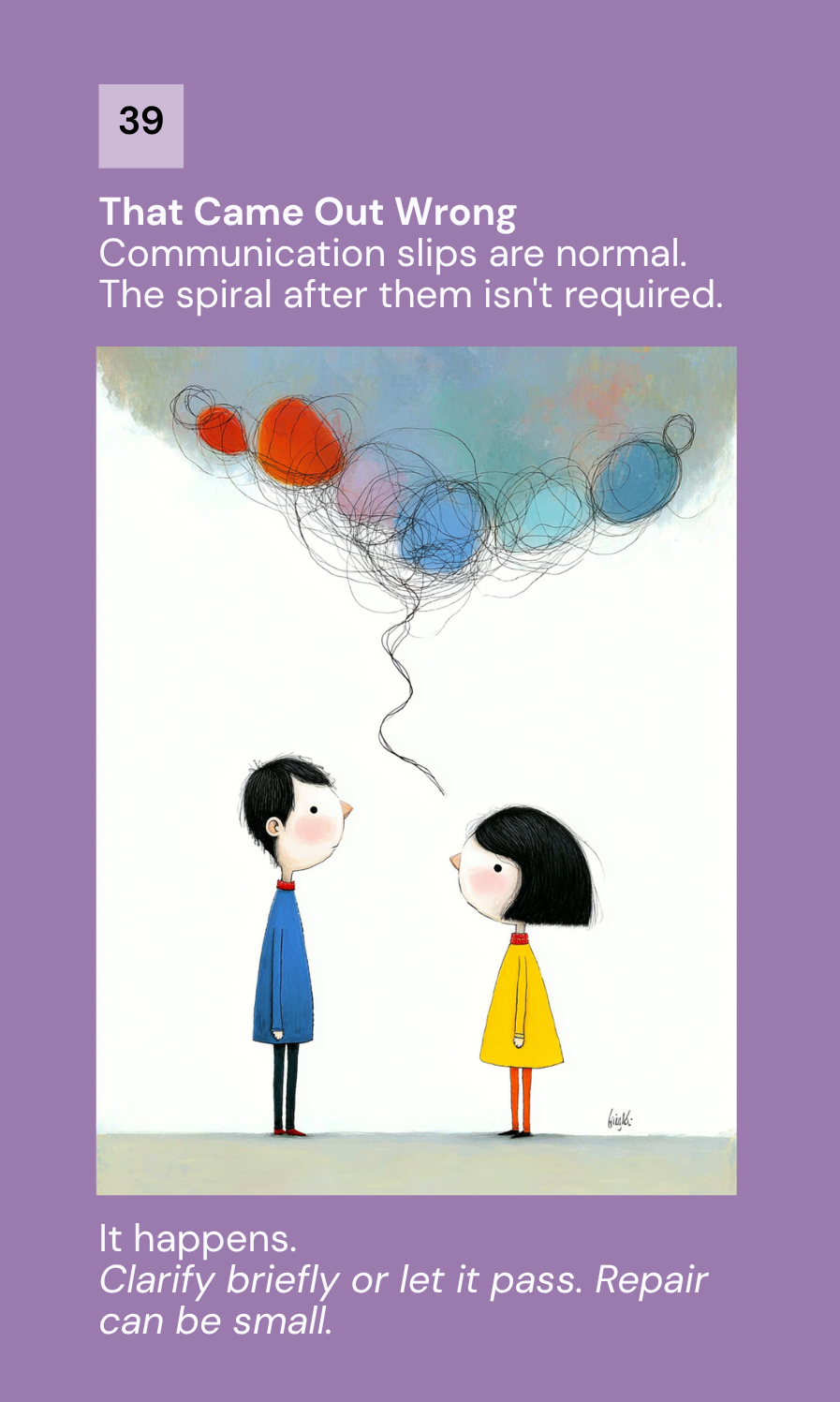
39. That Came Out Wrong. It happens.
Context Communication slips are normal. Words come out in the wrong order. Tone doesn't match intention. Context is missing. The spiral of self-criticism that often follows a communication mistake frequently costs more than the original slip.
What This Card Offers This card reduces that spiral. You can clarify briefly if it seems helpful, or let the moment settle without intervention. Not every misfire needs a full repair conversation. Repair can be simple — a brief clarification or just letting it pass. You don't have to be perfect in interaction.
Support A comment didn't land as intended. Communication slipped. Not every misstep requires a full repair. You are allowed imperfection in interaction.
Quiet Reassurance Slipping in conversation is human. Repair can be small.
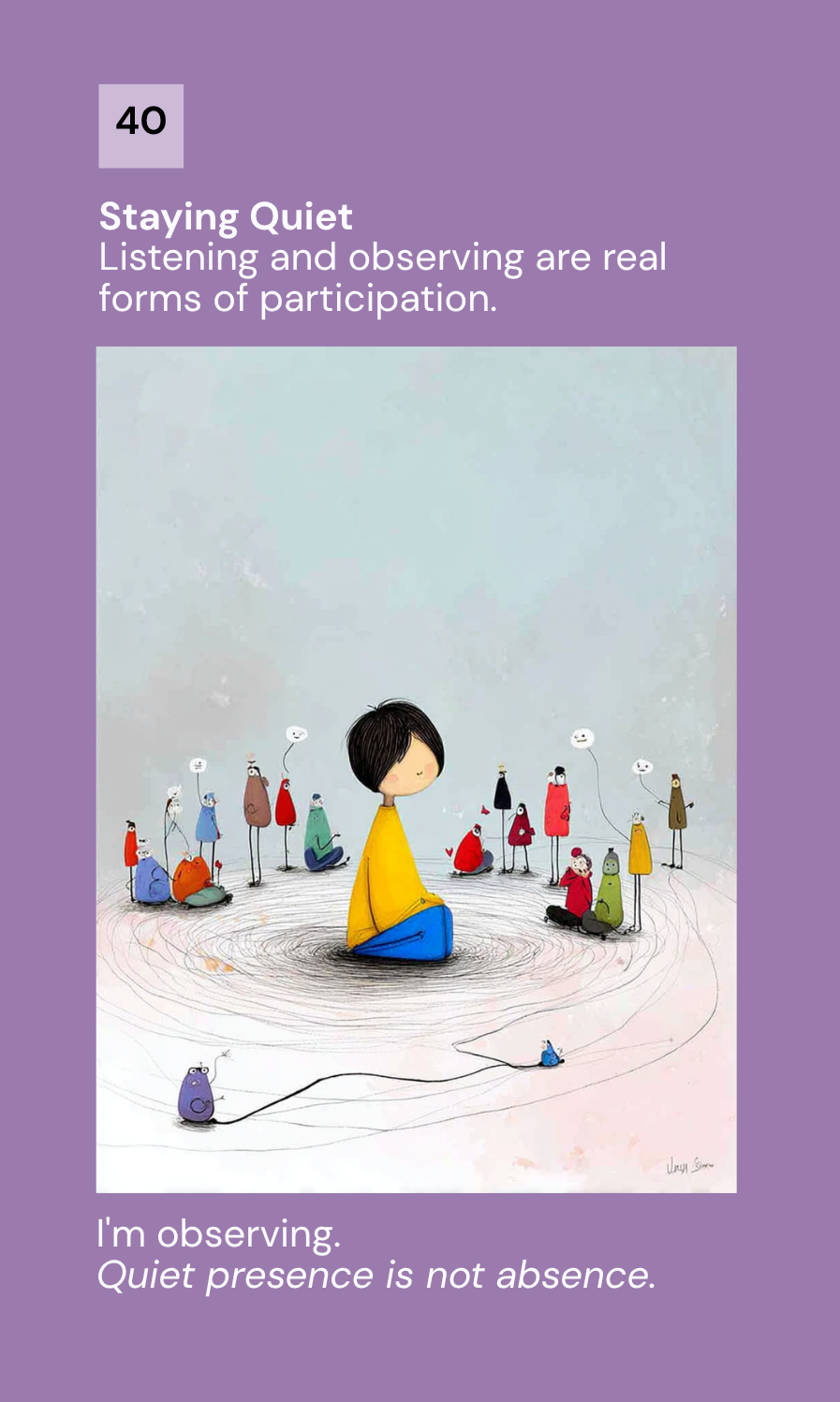
40. Staying Quiet. I'm observing.
Context Silence is often misread as disengagement, disinterest, or absence. In many social contexts there is implicit pressure to contribute verbally in order to be seen as present. This can cost significant energy for people who process or communicate differently.
What This Card Offers This card affirms that quiet presence is valid engagement. Watching, listening, and observing the dynamics of a conversation are real forms of participation. You can choose when to speak. You are not required to perform contribution in order to belong in the room.
Support You don't need to contribute right now. Listening is real participation. Watching the dynamics is a form of engagement. Silence doesn't mean absence.
Quiet Reassurance Staying quiet is not the same as being absent. You can be fully present without speaking.
Full Guidebook
-
Today Suit
Cards 1 - 10
-
Sensory Suit
Cards 11 - 20
-
Energy Suit
Cards 21 - 30
-
People Suit
Cards 31 - 40
-
Care Suit
Cards 41 - 50